The tourism industry is increasingly called upon to account for its environmental and social impact. Within the Northern Drakensberg, one family offers a practical example of how that responsibility can be translated into long-term practice.
Founded in the early 2000s by Anthony and Jean Carte, who had previously been involved with The Cavern Resort & Spa, Montusi Mountain Lodge is now under the leadership of the next generation, with Lindsay Du Plessis as Director. Although the business has evolved in recent years, its direction and ethos have remained consistent, with a focus on caring for the land, investing in people, and operating within the natural limits of its environment.
The decision to develop a more upmarket property was not an obvious progression for the family and required a period of learning as they adapted to the expectations of international guests, while preserving the character that had defined their earlier work.
Lindsay explains that the development of the lodge required both a willingness to adapt and a commitment to what felt authentic to the family. Having studied the practices of established operators, they made a deliberate choice not to overcomplicate the offering or compromise the personal nature of their hospitality.
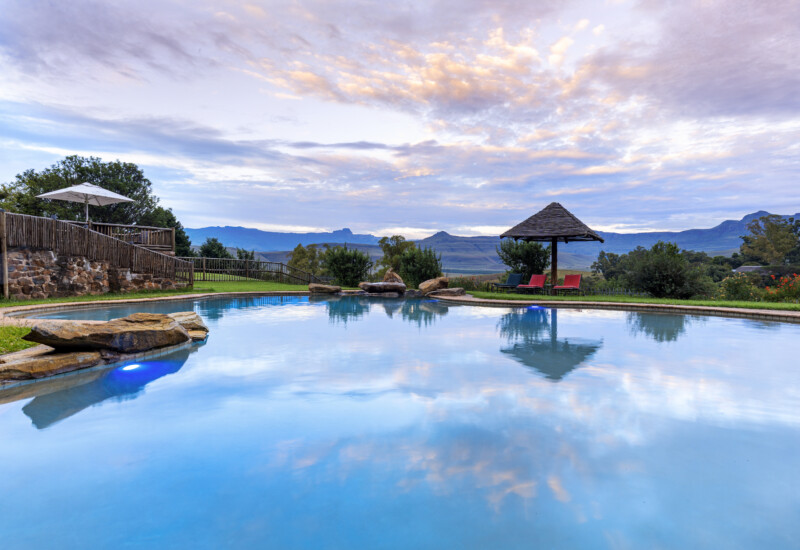
This philosophy is clearly expressed in the design of the lodge, which centres on generous space, privacy, and a direct connection with the surrounding landscape. Each suite is positioned as a separate structure with its own surrounding space, allowing guests to experience uninterrupted views of the Drakensberg while maintaining a sense of seclusion, and the use of thatch, stone, and other natural materials ensures that the buildings sit within the environment rather than stand apart from it, supported by a lighting approach that is deliberately minimal in order to reduce light pollution and preserve visibility of the night sky.
Alongside the development of the lodge, the business has maintained a strong emphasis on people, particularly in a rural context where access to trained hospitality staff was limited at inception. This led to a deliberate focus on training and developing local employees rather than relying solely on external expertise.
“Most of our staff have grown with us,” says Lindsay Du Plessis. “Some have been here since I was a teenager. They’ve helped shape the business just as much as we have.”
Many of the individuals who joined the lodge during its early stages remain part of the operation today, contributing to a stable working environment and a culture shaped by long term relationships and experience accumulated gradually over time. Lindsay notes that the continuity of staff has played a significant role in the development of the lodge, as employees have grown alongside the business and, in many cases, have contributed to its development through their experience and institutional knowledge.
A close and ongoing partnership with the Royal Drakensberg Education Trust (RDET) forms a cornerstone of the family’s community commitment. The Trust focuses on early childhood development and quality education for children in the local AmaZizi community, supporting them from infancy through their foundational school years. Guests are warmly invited to visit the school and witness first-hand the positive impact their stay makes to educational opportunities in the area, creating a direct and transparent link between the lodge’s success and community upliftment.
“Our main role is to act as a conduit between our guests and the Royal Drakensberg Education Trust,” says Lindsay Du Plessis. “We introduce people to the school and the work being done, so they can see it first-hand and understand the impact they are part of.”
Environmental management is treated as an ongoing operational responsibility, with the property requiring continuous attention, particularly in the removal of invasive plant species such as wattle, which can have a significant impact on water systems and biodiversity if left unmanaged. Water quality is monitored on a monthly basis, with testing conducted at both intake and discharge points, indicating that water leaving the property remains as clean as when it enters.
Lindsay emphasises that maintaining the health of the surrounding environment is fundamental to the long-term viability of the business, as the condition of the land is directly linked to the experience offered to guests and the sustainability of operations into the future.
Rather than relying on structured activity programmes, the lodge offers a more open and flexible approach that allows visitors to engage with the mountains at their own pace, whether through walking, exploring the grounds, or simply spending time in a peaceful setting removed from the pressures of daily life.
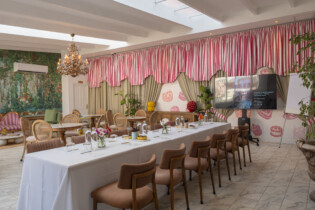
Recent work has focused on upgrading existing accommodation and refining the overall guest experience, with further improvements planned within the current operational scope, including enhancements to dining and shared spaces, reflecting a deliberate decision to deepen the quality of what is already in place.
Lindsay Du Plessis states that the current phase of development is centred on strengthening the existing offering, supported by a phased programme of upgrades that has already seen significant improvements to guest rooms and suites over the past year, including new in-room features and subtle refinements to the buildings themselves. Further enhancements are planned throughout the current year, with a continued focus on improving comfort and experience within the existing footprint, and no immediate intention to expand beyond what can be effectively managed within the current environment.
The direction of the lodge remains closely tied to the Carte family’s multi-generational history in the valley, which stretches back to the establishment of The Cavern by Bill and Ruth Carte in 1941 and includes earlier contributions to both tourism and conservation in the region, reinforcing a sense of continuity that continues to influence decision-making today.
Montusi Mountain Lodge presents a model shaped by family, heritage, and responsibility, where decisions are guided not only by the present, but by what will remain. At its core, the approach is about safeguarding what exists today, so that future generations may continue to care for the land, the people, and the sense of place that defines it.