The newly released Incentive Travel Index reveals an industry navigating higher spending, changing destination priorities, geopolitical uncertainty and the growing influence of artificial intelligence. But what do these findings mean for South Africa and the wider incentive travel industry?
The global incentive travel industry has a new benchmark for understanding where the market is heading, following the release of the 2026 Incentive Travel Index (ITI) at IMEX America in Las Vegas.
Produced by the Incentive Research Foundation (IRF) and the Society for Incentive Travel Excellence (SITE), in partnership with Oxford Economics, the annual research provides valuable insight into how organisations are investing in incentive travel, what motivates destination selection and which challenges are shaping future programmes.
Drawing on responses from 2,017 industry professionals across 83 countries, the 2026 survey presents a picture of an industry that remains commercially relevant but is becoming increasingly selective, strategic and risk-conscious.
For South Africa’s incentive specialists, destination management companies, hospitality providers and corporate event planners, the findings offer both an important reality check and an opportunity to reconsider how we position our destination and the experiences we deliver.
Spending is growing, but buyers are thinking differently
One of the most encouraging findings is the continued increase in incentive travel expenditure.
The Index reports that average global spending per participant reached US$5,500 in 2026, representing a 7.8% increase on the previous year’s US$5,100.
However, this increase does not necessarily mean buyers are becoming less budget-conscious.
Looking towards 2027, 30.7% of surveyed buyers expect to trim their programmes, while 52.1% anticipate adjusting budgets in line with inflation. Only 17.2% intend to improve programme quality through increased spending.
Interestingly, the outlook becomes more positive for 2028, when 32.1% of buyers expect to improve their programmes.
The Planner Guru’s perspective: The message for our industry is clear: higher expenditure does not automatically translate into a willingness to pay more for the same experience. Suppliers must increasingly demonstrate why their offering represents genuine value. Creative itineraries, thoughtful inclusions and experiences that achieve measurable objectives may become stronger selling points than luxury for its own sake.
Destination confidence is becoming a deciding factor
The 2026 research places significant emphasis on geopolitical uncertainty and the effect it is having on destination selection.
A notable 60.5% of buyers report that geopolitical instability is already disrupting destinations they use, while 83.3% indicate that geopolitical sentiment has influenced their booking behaviour during the preceding 12 months.
The implications go beyond simply choosing a different country. Buyers are reassessing destination risks, reviewing travel arrangements and increasingly considering the reliability of local partners.
When identifying reasons to rule out destinations, 64.5% of buyers cited geopolitical factors, while 62.2% identified difficult air access.
For South African operators, these findings reinforce the importance of communicating clearly about accessibility, travel logistics, destination safety and contingency planning.
A beautiful destination may generate initial interest, but confidence in its ability to deliver a seamless experience can ultimately determine whether that enquiry becomes a confirmed booking.
What does the Index reveal about Southern Africa?
Perhaps one of the most important findings for our local industry concerns changing destination preferences.
Western Europe leads the Index’s destination momentum rankings at +29.3 percentage points, followed by Emerging Europe at +25.3 points and the Caribbean at +20.7 points.
Southern Africa, meanwhile, records net destination momentum of -3.1 percentage points among surveyed buyers already using the region.
Importantly, this does not mean incentive travel to Southern Africa has declined by 3.1%. The figure represents the difference between buyers planning to use the destination more and those planning to use it less, relative to 2026.
It is also a global survey, not a South Africa-specific demand forecast.
Nevertheless, the results deserve attention.
South Africa offers an extraordinary combination of luxury accommodation, wildlife experiences, cultural diversity, world-class hospitality, adventure and distinctive event locations. These strengths remain valuable, but international destination competition is intensifying.
Our view: We cannot rely solely on beautiful landscapes, iconic attractions or the appeal of a safari to secure future incentive business. Our industry needs to strengthen its messaging around accessibility, reliability, innovative programme design and the unique business value of incentive travel in Southern Africa.
Strong collaboration between tourism bodies, venues, airlines, DMCs and incentive specialists will remain essential.
Creativity, quality and personalisation are taking centre stage
The Index also highlights a shift in what buyers value when selecting destinations and delivery partners.
Top-tier accommodation has become the leading destination must-have, identified by 47.9% of buyers, compared with 34.3% in 2025.
Meanwhile, when selecting destination management companies, 81.2% of buyers prioritise creativity, with 79.5% identifying reputation as an important consideration.
These findings reflect the growing importance of how an incentive experience is designed, rather than simply where it takes place.
For South African suppliers, this creates opportunities to develop more intentional programmes that showcase local culture, authentic interactions, exceptional hospitality and memorable experiences.
The opportunity is not necessarily to create more extravagant itineraries, but to create better ones.
This is reinforced by another interesting finding: 61.7% of respondents agreed with the proposition that a well-designed programme in a secondary city can outperform an underwhelming programme in an iconic international destination.
For a country with such a diverse destination offering, that is a particularly relevant insight.
Artificial intelligence is no longer a future consideration
Technology is also reshaping the incentive travel planning process.
According to the Index, 60.8% of respondents who answered the AI-use question are using or planning to use artificial intelligence across three or more applications, while 22.9% report five or more.
Among buyers, destination research and planning is the leading AI application, at 76.6%.
From researching destinations and developing itineraries to creating communications and modelling programme scenarios, AI is becoming embedded in everyday planning activities.
However, the Index suggests that measurable competitive advantage has not yet caught up with widespread adoption. Only 24.4% of respondents believe AI users are already outperforming competitors on price or programme quality.
For planners and suppliers, the opportunity lies in using technology to improve efficiency while protecting the personal relationships, local knowledge and human creativity that make incentive programmes exceptional.
A stronger case for demonstrating value
Another particularly thought-provoking finding is that 76.2% of respondents believe educating the next generation of corporate HR and finance leaders about the benefits of incentive travel would be a better industry investment than simply developing new destinations or better hotels.
This points towards a broader challenge: demonstrating the business value of incentive programmes.
Incentive travel is not simply a reward or a luxury getaway. When strategically designed, it can support performance, strengthen professional relationships, encourage engagement and contribute to organisational objectives.
For our industry to continue growing, these outcomes need to form a stronger part of the conversation with corporate decision-makers.
The Planner Guru’s view
The 2026 Incentive Travel Index reminds us that the future of incentive travel will not be determined by spending alone.
It will depend on how successfully the industry balances commercial objectives with memorable experiences, how confidently destinations respond to uncertainty and how effectively suppliers communicate their value.
For South Africa, the opportunity is significant, but it requires a proactive approach.
We need to move beyond simply promoting what makes our destinations beautiful and demonstrate what makes our incentive experiences exceptional, accessible, professionally delivered and worth investing in.
The strongest programmes of tomorrow may not necessarily be the most expensive or the most elaborate. They will be those that deliver clear business value while creating experiences participants genuinely want to earn.
Access the 2026 Incentive Travel Index
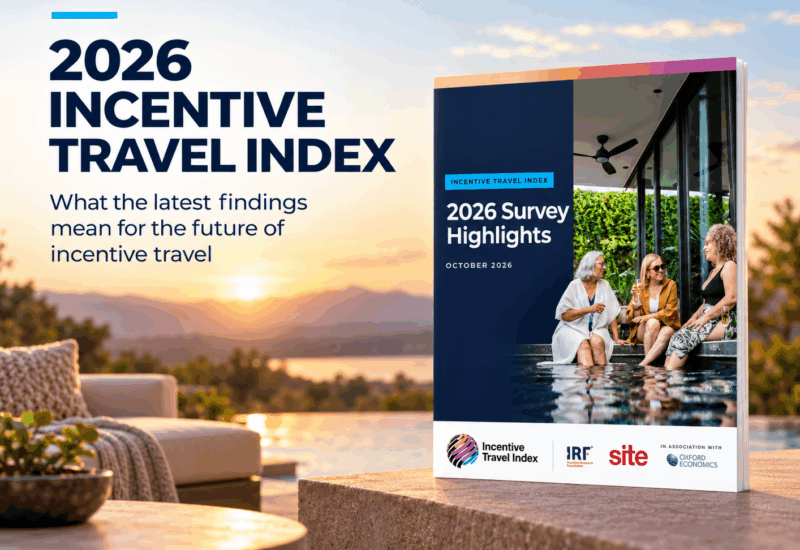
The 2026 Incentive Travel Index Survey Highlights are available through the official Incentive Travel Index website.
Readers can explore the findings covering spending trends, geopolitical risk, destination selection, strategic planning and artificial intelligence.
Access the 2026 Incentive Travel Index here
Visitors will be prompted to complete a short form to access the survey highlights.
Source: 2026 Incentive Travel Index Survey Highlights, October 2026 — Incentive Research Foundation, SITE and Oxford Economics.
The 2026 Index in Numbers
- 2,017 industry professionals surveyed across 83 countries.
- US$5,500 average incentive travel spend per person in 2026.
- 7.8% increase in spending compared with 2025.
- 60.5% of buyers experiencing geopolitical disruption to destinations.
- 47.9% of buyers identify top-tier accommodation as a destination must-have.
- 81.2% prioritise creativity when selecting DMCs.
“For South Africa, the opportunity lies not only in showcasing extraordinary destinations, but in proving that we can deliver exceptional incentive experiences with creativity, confidence and measurable value.” — The Planner Guru, editorial perspective